
The Flight
A new story with a special guest illustrator

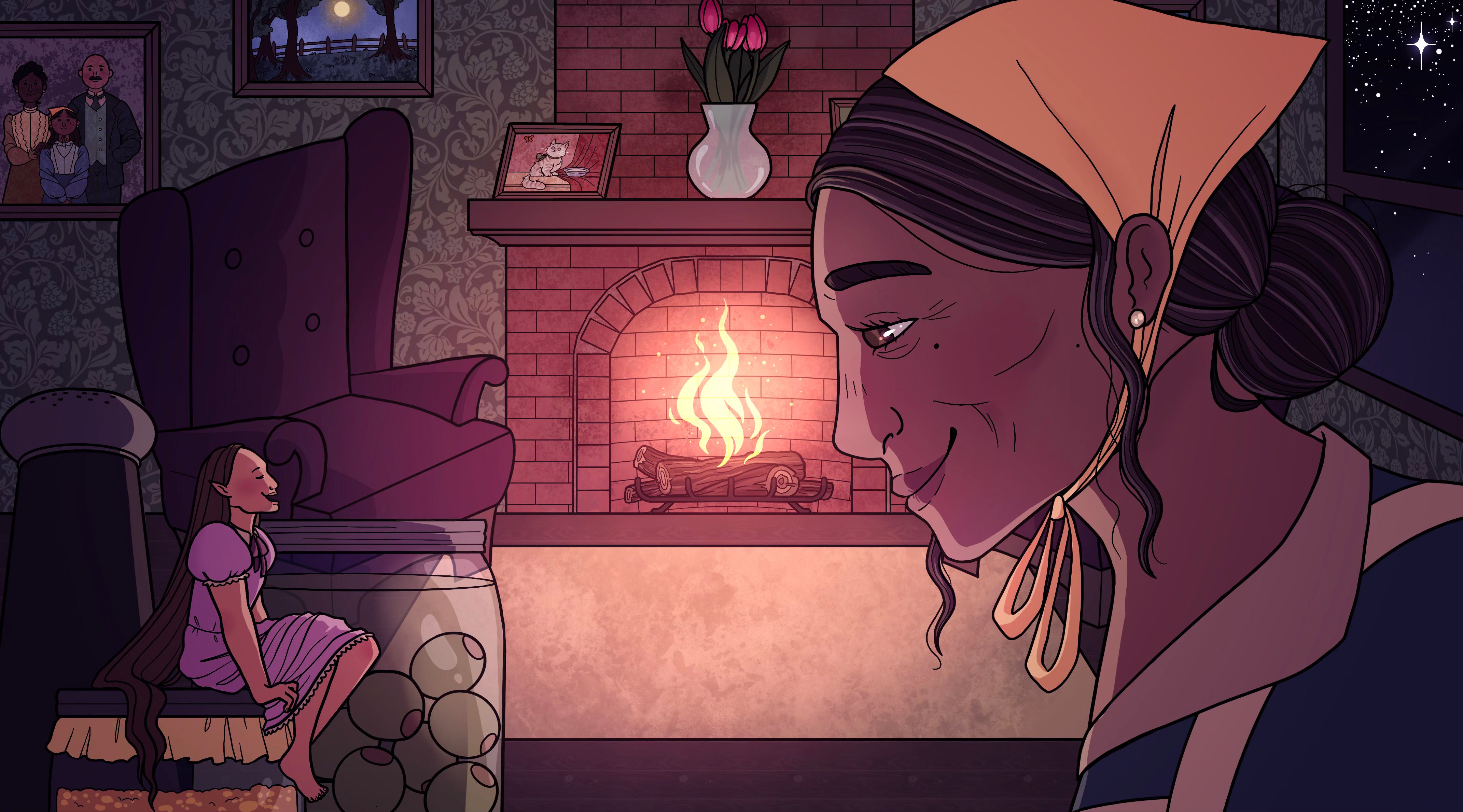
I wrote the first draft of this story a few years ago, when being a mother was beginning to feel like a process of learning how to let go. I’m putting this story out in the world just as I am about to become an empty-nester. Many thanks to my talented daughter, Alaina Haylock, for the illustration.
The Flight
Like any mother, she never saw it coming. She was the main character, or so she thought. It was only later that she understood. The story was never about her at all.
*
Once, there was an old woman who lived in a cottage at the edge of a pond. So the story began. Mind you she wasn’t that old. Not really. But that’s what the story required. A childless old woman who longed for — and then was blessed with — a child.
Did she long for a child? The truth is she was content enough. She had her cottage, her garden, her hens. She made a comfortable living selling eggs and vegetables at the market. And when the day’s chores were done, she did as she pleased.
But the day she found Lilibet, something cracked open inside her. A part of her she hadn’t even known was there.
It was springtime. The old woman was tending her garden. A tree swallow flitted over the pond, its feathers glinting indigo in the sunlight. As the old woman watched, the swallow flew to an ancient oak that stood outside the garden gate. The bird disappeared into a hole in the trunk. After a few moments, it emerged and flew away.
The old woman hurried to the oak tree and peered inside. There, she found a nest with two pale pink eggs and a tiny baby girl, naked and small as a newborn mouseling.
The old woman gently scooped the sleeping baby into her hand and took her inside. She swaddled the child in a square of fabric cut from a handkerchief and set her to sleep in a walnut shell. The old woman named the baby Lilibet. She fed her applesauce and milk-soaked breadcrumbs. She stitched tiny dresses and adorned them with scraps of ribbon and lace.
The baby grew into a little girl, and then into a young lady. But still, she was no bigger than the swallows that came and went with the seasons. The old woman would not allow Lilibet to help with the cooking, lest she fall into the soup pot. She couldn’t help with the chickens, for fear they would peck her. And she was too small and too weak to be of any real help in the garden.
“Sing to me,” the old lady said. “That is all I ask.” For Lilibet’s sweet and lilting voice made the old woman feel as if she were carried on the wind, like a cloud drifting across the sky. And so every night after dinner, Lilibet sang while her mother cleared the dishes.
Theirs was a household of laughter and warmth for many years. Then, in the summer of her fourteenth year, Lilibet grew moody and restless. She longed to see the world beyond the confines of the cottage. But the old woman said the great wide world was too dangerous for such a small and helpless girl.
One day, while the old woman was at market, Lilibet slipped out the window and walked down to the pond. She soaked her feet in the cool water. A tree swallow flew overhead, swooping down now and then to snatch a bug.
After a while, the swallow alighted on the bank next to Lilibet.
“What are you?” asked the bird, examining her.
The tiny girl giggled. “I’m Lilibet.”
“What’s a Lilibet?” asked the swallow.
“That’s my name,” she laughed. “My mother named me that because when I was a baby, I was so tiny.”
“Huh,” said the swallow.
“She’s at the market now, selling eggs,” said Lilibet.
The swallow made an alarming metallic screech.
Lilibet’s face burned with shame. “Mother will be back soon,” she said, and she hurried back to the cottage.
Lilibet could not stop thinking about the swallow. The next week, when her mother went to market, she went down to the pond to talk with the swallow again.
The next morning, when the old lady set down a platter of scrambled eggs for breakfast, Lilibet shrieked “murder!” and ran from the table. Soon, Lilibet refused anything the old woman cooked, preferring to make a meal out of fresh berries and dewdrops and insects she found hiding in the corners of the cottage. Then, it was the clothes. Lilibet no longer wore the dresses the old woman sewed for her, and began to fashion her own clothes out of flower petals and leaves.
“It’s just a phase,” said the ladies at the market. But sometimes, the old lady looked at Lilibet and wondered where her daughter had gone.
One day, late in summer, Lilibet and the swallow sat for hours at the edge of the pond. They talked about mothers, about freedom, about wildness. The swallow said it would soon be time to go south for the winter. “You do not have to live in a cage,” said the swallow.
Lilibet asked the swallow to fetch her some berries from the garden. She crushed them in her hands and worked them into her scalp until her hair was stained indigo.
“Fierce,” said the swallow.
That evening, when Lilibet came back to the cottage, the old woman was silent about her hair. She said nothing about Lilibet’s stained and torn flower petal dress. She tentatively set a small dish on the table. “Bayberries, your favorite.”
Lilibet ate in silence.
After dinner, the old woman asked Lilibet to sing.
Lilibet stood on the table and glared into the old woman’s eyes. From the back of her throat, she produced a metallic stream of chirps and warbles.
“Lilibet,” said the old woman in a voice scarcely louder than a whisper.
“Never call me that again!” shouted the girl. “That is not my name!”
Tears sprang to the old woman’s eyes. “What should I call you, then?” she asked.
The girl made a bird-like trill that the old woman could not comprehend, and then ran from the cottage.
From edge of the garden, the old woman watched her daughter run to the pond, where the swallow was waiting. Lilibet hopped onto the bird’s back. The swallow looked back at her, but did not move. “You can fly, you know.”
Even as the swallow said it, the old woman knew it was true. Lilibet spread her arms and sprouted feathers.
Then she leapt into the air.
Illustration by Alaina Haylock (Instagram @faraway.moon)